Posted in animals, cryptozoology, giant birds, monsters, pterosaurs, strange creatures, thunderbirds, Uncategorized, unexplained phenomena | Tagged mystery birds, wings |
Want a fast pictorial on how I became a creature investigator and author? Here’s an unsolicited, unexpected, unremunerated short video from art teacher Andy McGraff at Lakewood Elementary in Twin Lakes WI. He created it as part of his exploration of area artists for his students’ “learning at a distance” program. My connection with Andy is that I have a degree in art education and often subbed in the Lakewood art room where Andy now works (when the schools have not been closed due to a monstrous virus invasion.) Andy includes some of the original “Inside Edition” footage from the early days of the Bray Road saga, and other undescribable things that made me laugh. It’s on Youtube at https://youtu.be/6bnAH8hpVQU
Posted in animals, Books, Bray Road, comics, crazy video, cryptozoology, cryptozoology art, dogman, Montana wolf, strange creatures, Uncategorized, unexplained phenomena, werewolves | Tagged Bray Road |
Their business names–the Dairy State’s “Wisconsin Big Cat Rescue and Educational Shelter” and Tampa, Florida’s “Big Cats Shelter” (a.k.a. Greater Wynnewood Animal Park) are similar–and both take in tigers, lions and other hulking felines with nowhere else to go. But the two animal parks could not be more different in their goals and personnel, says Rock Falls, WI’s Jeff Kozlowski. He and his wife, Jennifer, run a small non-profit specializing in programs for school children, while Florida’s Big Cats Shelter is something else–in any way you wish to take that phrase.
But in summer 2019, my fledgling crew (White Lhasa Studios LLC) and I were busy filming in and around Hillsboro, Wisconsin. Kozlowski was on our list for his knowledge of big cats. We were totally unaware of the concurrent production of a TV series titled Tiger King after its flamboyant and freewheeling Floridian owner, known as Joe Exotic.
While Joe Exotic is the mainstay of the TV series, Kozlowski isn’t featured on the TV show and he has said on area media that he doesn’t mind at all. His interview with us for our award-winning* indie documentary, Return to Wildcat Mountain; Wisconsin’s Black Panther Nexus, involved possible big cat escapes and whether romance between jaguars and pumas could produce hybrids or occur at all. Our big ask, then, was whether a black jaguar could mate with a mountain lion to produce the mysterious black “panthers” we tracked. Kozlowski had a reasonable answer. We found him knowledgeable and willing to share his thoughts on every facet of big cat rescue.
Since Kozlowski is an important presence in Return to Wildcat Mountain, we also wanted to show him at his well-kept compound with a few of his own words. If you’d like to see more of our film, you may click the options below:
and DVD’S HERE. (Dvd’s on sale until June 20th, 2020. Use Promo Code SPRINGCATS at checkout.)
*Return to Wildcat Mountain, released April 2020, won Best Documentary in the 4th Annual Midwest WeirdFest film festival, April 7-9 2020
Random Synchronicity of the day: Joe’s shelter is located in Florida’s Hillsborough County, while the Wisconsin shelter is only a bit over 15 miles from the Village of Hillsboro where we did the most work. Some would call this association of certain human and place names, “the name game.”
Posted in animation, big cat shelters, cryptozoology, cryptozoology art, ghost cats, Linda Godfrey, mountain lions, Uncategorized | Tagged big cat, Joe Exotic, Kozlowski, Tiger King |
Just in time for Easter…
Throughout the annals of cryptozoology, every once in a while a truly odd cryptid shows up. About this time this year I think of Virginia’s Bunny Man, hunted by Fairfax County Sheriff’s Deputies as it hopped through fields and neighborhoods, occasionally throwing a hatchet through someone’s window. Everyone agreed it was a human dressed in a furry suit, usually white. There is a bridge named after him by locals, and a collection of crazed local lore in “Weird US,” 2004 by Mark Sceurman and Mark Moran.
Lesser known and more benign is the Michigan Bunny Man, which is more on the order of upright, over-sized animals.
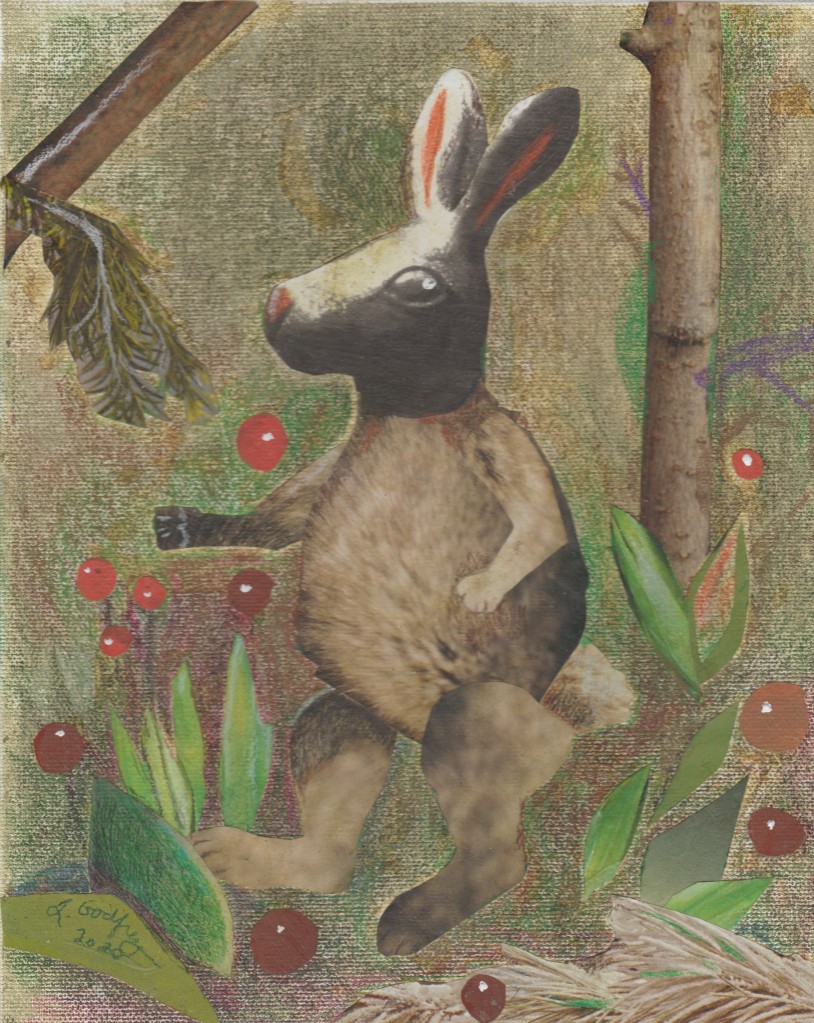
In this version, the five-foot tall, upright rabbit creature was seen by a woman working at a camp in Michigan’s Upper Peninsula in 1958, between Paulding and Bruce Crossing. The woman’s daughter said it ran away from her mother on two legs. The woman, whom I met at a book signing in Iron Mountain, said her mother wasn’t the type to make things up, and often marveled that she had seen such a thing. It also happens that this area is almost the exact spot of the famed Paulding Lights. The illustration is my own fanciful interpretation of the creature. Happy Easter!
Posted in cryptozoology, cryptozoology art, Light Anomalies, Uncategorized | Tagged Bunny Man, Michigan, Paulding lights |
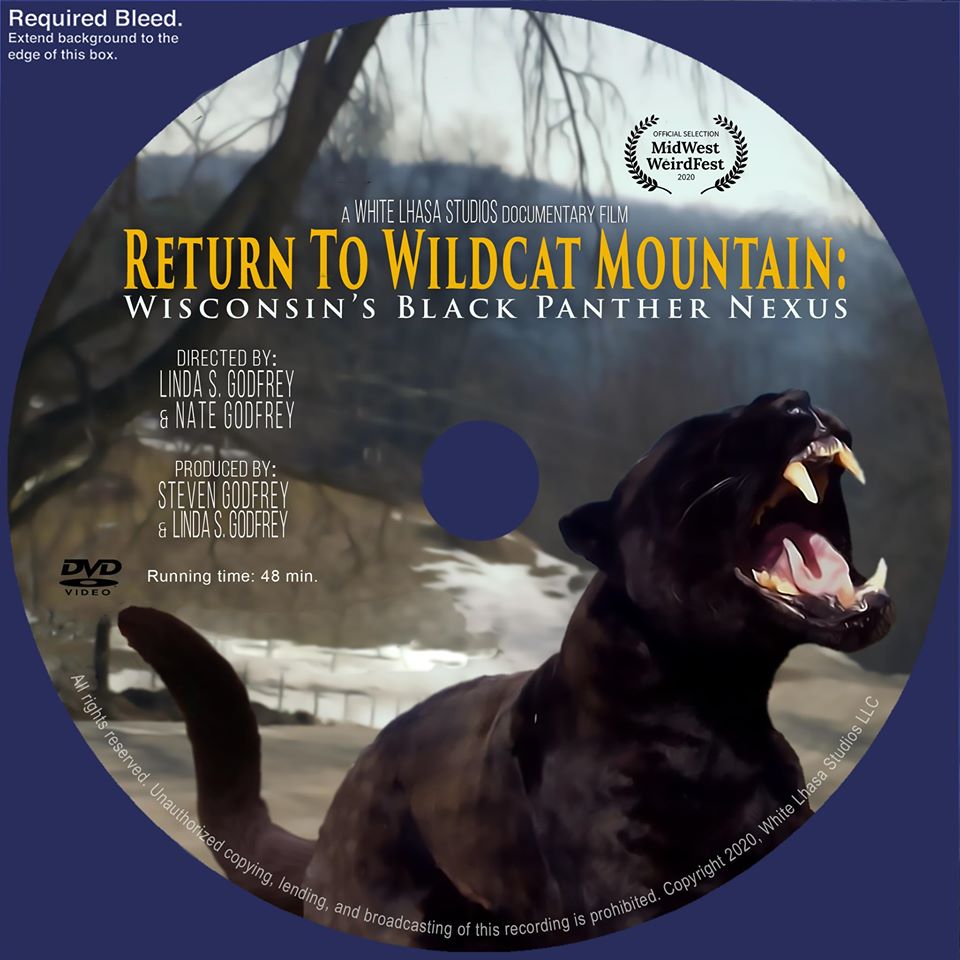
It’s almost here! Click to see http://www.midwestweirdfest.com/program#/event-linda-godfrey-at-volume-one-sat-mar-7-300pm/ for the program. First run DVD’s will be available, and streaming announced soon.
Posted in Uncategorized |
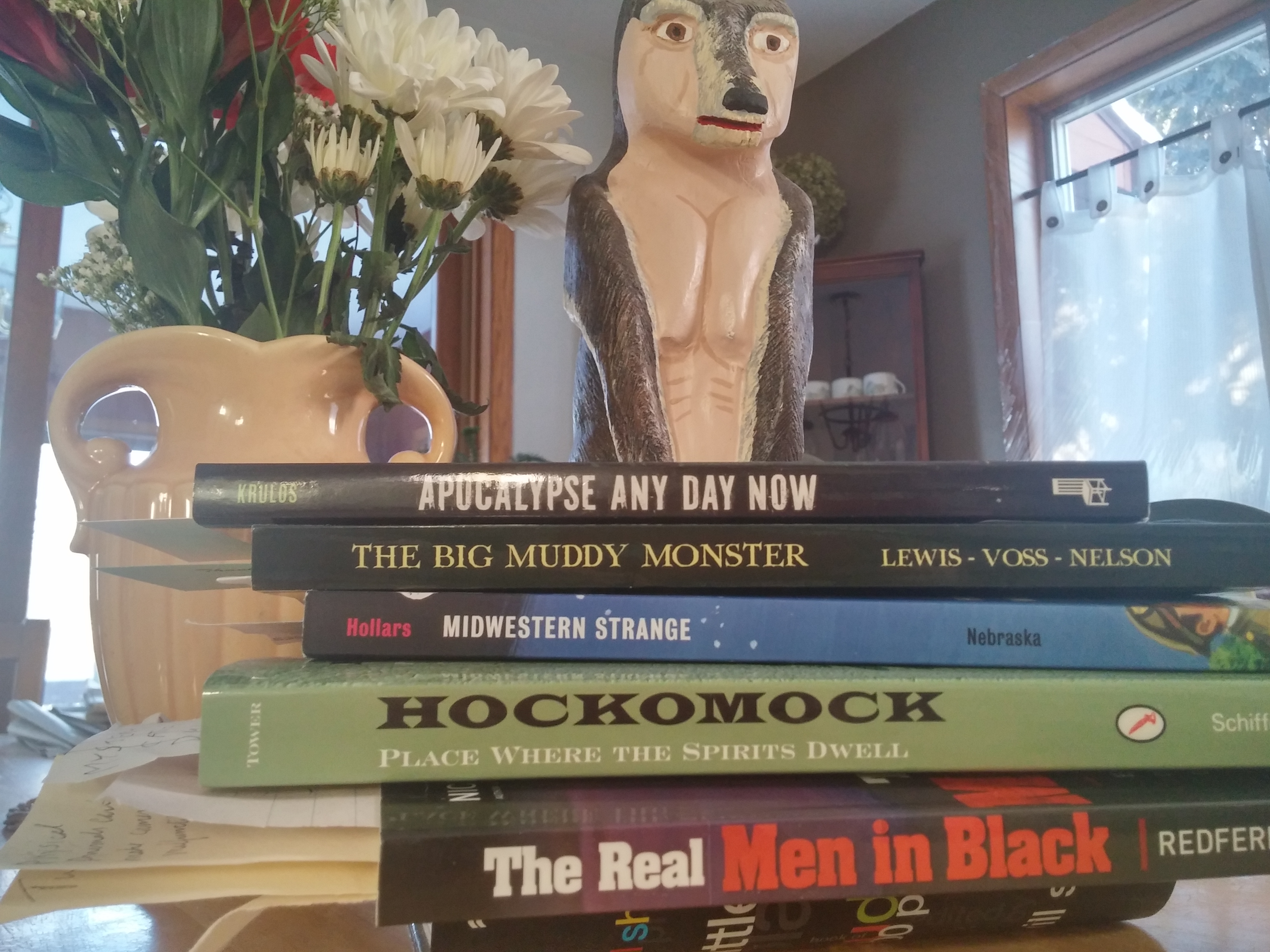
When I riff through my personal library shelves, I can pick out the books I most love and use by the number of makeshift bookmarks—shreds of Kleenex, ancient business cards, even cereal box tops– hanging out of them. It’s not that I don’t have any traditional bookmarks. It’s just that choosing the right gum wrapper or creased photo feels more organic; almost a crude art form. (I admit sometimes I’m just too lazy to go find a “real” one.) A few days ago I noticed five great books overflowing with found scraps, and decided to share not only their titles but also the added bits of flotsam and jetsam that distinguished them. SO, in no particular order:I
#1, and winning best title award, is Apocalypse Any Day Now by Tea Krulos, 2019, Chicago Review Press. In this witty first-hand survey of various disaster-prepping people and other live-for-today-plan-for-tomorrow folks, I used a “5-Below Store” receipt to mark the page of a checklist of things to take when the human race inevitably moves to Mars. I also used a quick-start booklet from my dash cam box instructions to note a page discussing zombies.
#2 For The Big Muddy Monster, by Chad Lewis, Noah Voss and Kevin Nelson, “On the Road Publications” 2019,” I chose a “get out of fines free card” I received from Elkhorn’s Matheson Public Library, and a bulletin for the annual Van Meter Visitor Conference hosted by the three authors. The first page I marked holds a particularly interesting passage on theories regarding “window areas,” or places where various unknown creatures and phenomena manifest and perhaps have Happy Hour. The other marker begins discussion of a Bigfoot-like creature associated with central Illinois in the mid-20th century, and many other paranormal and cryptid puzzles hunted in person by Lewis, Voss and Nelson. These guys camp in monster territory when it’s ten below zero! They are the real thing.
#3 Midwestern Strange, written by associate professor of English at UW-Wisconsin, Eau Claire; University of Nebraska Press, 2019. I could easily find something to mark every page in this recounting of, as his subtitle says, “Monsters, Martians and the Weird in Flyover Country.” But I used the note from my dog’s vet informing me it was time for Grendel’s heartworm pills to mark Hollars’ section on the Beast of Bray Road. It includes a copy of my first newspaper drawing of the creature. There are also chapters on Rhinelander’s famed Hodag, West Virginia’s Mothman, and the Kensington Runestone, among others. For sure, there are enough subjects backed by elegant historical facts to lose that “Flyover” name forever!
#4 Hockomock, Peter Tower, published by Shiffer, 2013, at first seemed like an outlier with its earlier date and a title taken from an Algonquian phrase meaning “where the spirits dwell.” But the book is an intriguing inlier. Today its title refers to a 6,000 acre, swampy conservation area in Massachusetts also known as the Bridgewater Triangle, said to be the locus of all forms of paranormal and cryptid events—as well as many human tragedies. I have a torn piece of notebook paper showing me where the section on black mystery cats begins, a fish-shaped shopping list marking where to find a 1979 UFO incident report, and some small Post-It tabs at the beginning of the black dog info. There are tons of nooks and crannies to explore here yet, and I will need a well-filled wastebasket to mark it thoroughly.

#5 The Real Men in Black, Nick Redfern, New Page Books; 2011, boasts a bunch of bookmarks. One, a hand-stamped fake luggage tag, says “Art saves lives.” I think that’s true. But art has its dangers. I used this tag to remind me of a particular study of the Loch Ness Monster in which the late investigator Ted Holiday witnessed a “man-in-black” figure watching him from a position slightly above the loch in 1973. Holiday felt deep “malevolence and abnormality emanating from the cold, passionless entity…” and then saw the figure instantly vanish. On his next visit, Holiday suffered a heart attack at the exact spot where the man in black had stood. This book is full of other odd MIB incidents that stand on their own merit but also document other strange events that occur in tandem with these visitations, from fairies to UFOs.
I enjoyed this journey into trash ephemera so much that I plan to do it again soon. So many economy motel notepads, so little time.
Posted in Uncategorized |
-

Strangely, in some parts of North America, black big cats make up over half the eyewitness reports of mountain lions, but zoologists say black pumas don’t exist. If that’s true, then exactly what are these ebony felines? Some say they are mutations or hybrids, others point to ancient beliefs of area Native Americans that the black big cats are guardian spirit animals. Might one small central Wisconsin town hold a clue to this growing mystery?
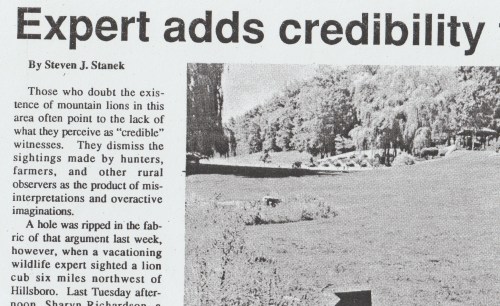
This puzzling and eerie phenomenon is the basis (as written in my book, “I Know What I Saw” ) for my debut film documentary as director/producer of Return to Wildcat Mountain; Wisconsin’s Black Panther Nexus.The film has been unanimously selected in one of the premiere release positions March 7th at the Midwest Weirdfest Film Festival in Eau Claire, Wisconsin.

I provided original art and served as writer and director, with my husband, Steve Godfrey, as co-producer. Our son Nate Godfrey, a film maker with a degree from the School of the Art Institute of Chicago, also lent his directorial skills, and created the camera, audio, anOur Indie Documentaryimation, and editing. ..pretty much everything that required hands on film know-how. Former newspaper editor/journalist Steven Stanek, Hillsboro WI, shared the decades of amazing eyewitness reports he has collected for his news column and became our field producer.

Streaming is now available at http://www.reelhouse.org/whitelhasastudios/return-to—wildcat-mountain/
Also see Facebook’s Return to Wildcat Mountain page.

White Lhasa Studios LLC, copyright 2020 all rights reserved.
Posted in Uncategorized |


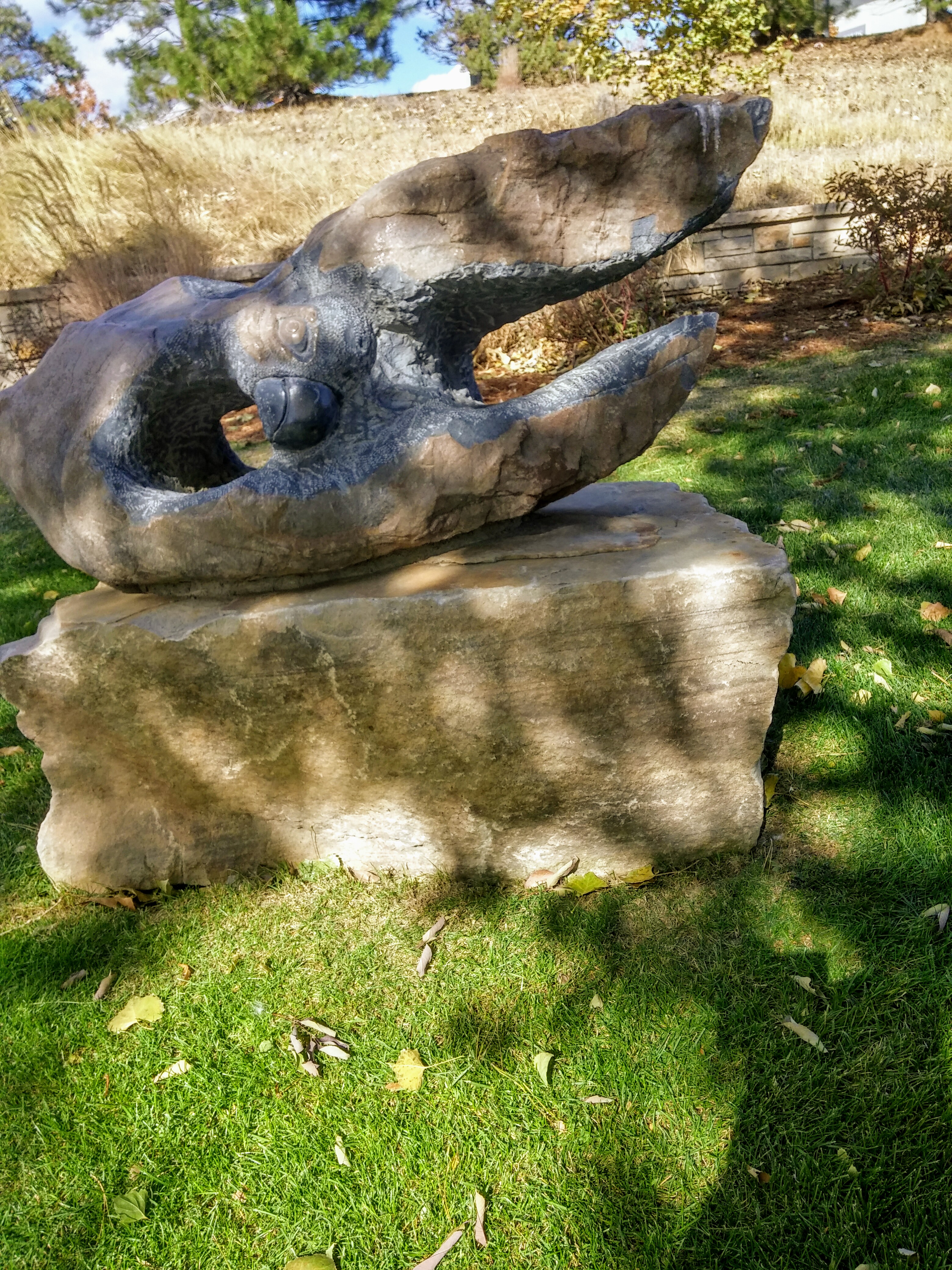
Great flying creatures–from giant humanoid bat-beasts to heavenly, silver-white, stork-like flyers–date back to the art and story cultures of most ancient civilizations around the world. Many of us are already familiar with ornithoids of early Sumerian and Egypt, Native American thunder birds, and other well-known examples, so it’s always a delight to find giant birds in places I’ve personally missed. A few months ago in Loveland, Colorado, my husband and happened upon just such a treasure. We were there to show a half-hour sneak peek of Return to Wildcat Mountain at Longmont’s Charles Dickens Horror Film Festival, when we found something lovely.
Here, the various types of Chapungu or “Great Spirit Bird” of Zimbabwe are depicted in stone sculptures created by modern-day African artists, the Shona people. The sculptures–with explanatory plaques–are displayed in a large, gracefully landscaped park. The Great Spirit Birds are said to protect the people and to warn of coming bad events (Pt. Pleasant’s Mothman and bridge collapse come to mind as an American parallel).
I’ve included a few of my own photos here but there are many more resources online. A good place to start is at http://www.chapungusculpturepark.com . (Note: Links have been a bit problematic) And keep looking up! Who knows what else is flying around up there, waiting for some writer or artisan to take lasting note?
Posted in African art, animals, chupacabra, cryptozoology, cryptozoology art, giant birds, strange creatures, thunderbirds, Uncategorized | Tagged animals, art, travel, wings |
My continuing mini-experiment with the deck trespasser: (see previous post)

My original placement of my randomly selected item
Something or someone is still visiting my deck. Not to make too much of this but it’s a bit strange even if it’s an unknown human hanging out illegally in my back yard in wee hours of the morning. And so many readers have expressed interest that I thought I should share the most recent development.
Earlier this week, I decided to remove the 5 white landscaping rocks that still formed a perfect pentagram near the edge of my backyard. I threw them in the Green Belt woods and replaced them with two different pebbles; a small granite piece and a larger, flat old river rock. I added a tiny plastic dinosaur, and intentionally laid it on its side, directly on the deck so it wouldn’t get blown away, as it has been quite windy here. Nothing happened for days.
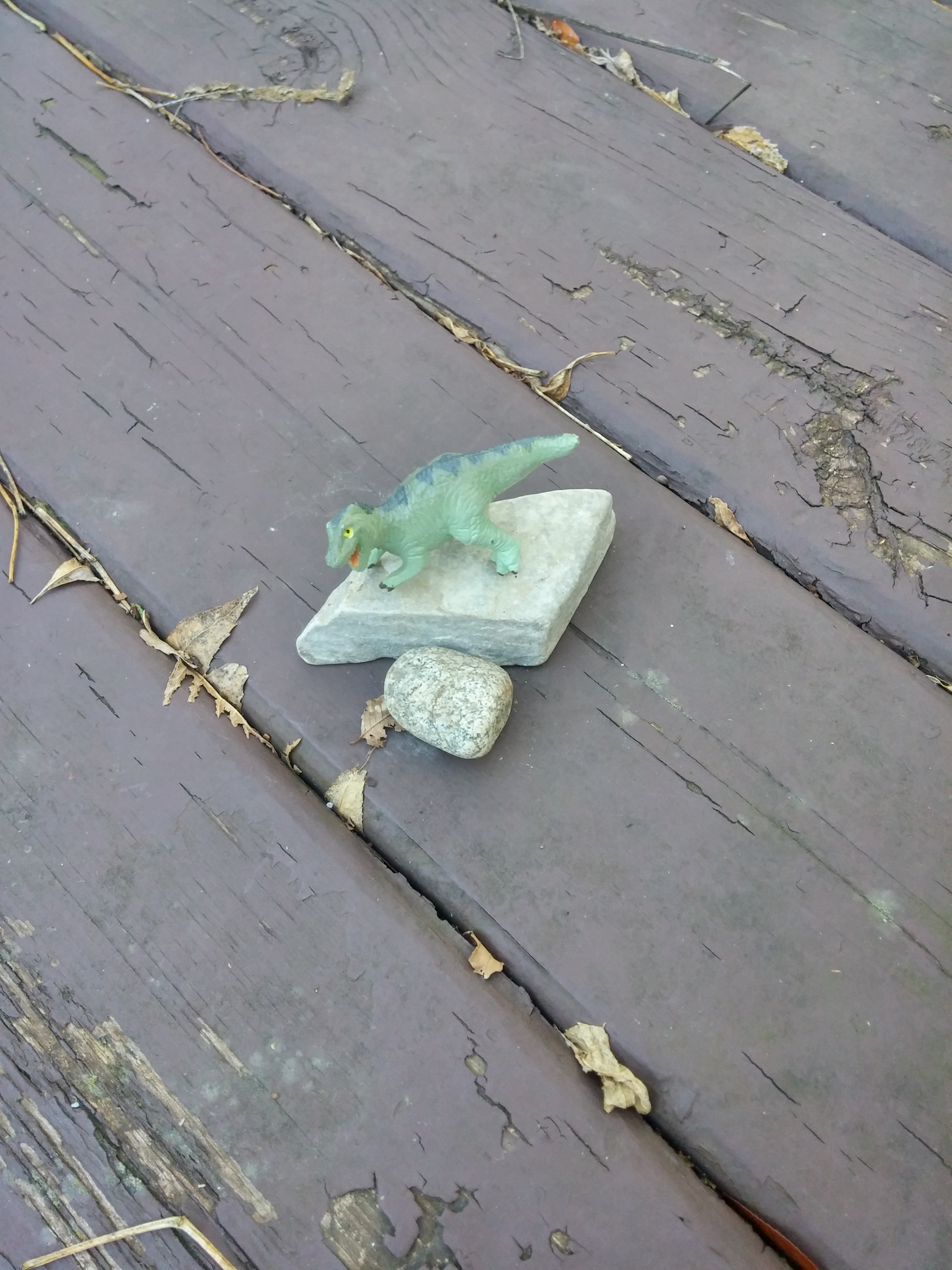
The change made by unknown agent that has remained in place for several days.
Tuesday a.m. on Dec. 3 I looked for it first thing and realized the granite stone which had been stacked squarely on the river rock was now lying next to it but still touching. But the normally tipsy dino had been set up to stand on top of the rock! The formation has survived a windstorm since then, still standing. In the photos you can see how it first looked when I placed placed it on the deck planks. No way the little dino somehow blew upward to stand solidly upright while the small granite stone rolled off the larger rock.
Is the culprit a human trespasser? Living in a populated area as I do, it would seem the most likely solution. (We do live on the very edge of town with nature trails surrounding.) But the sudden appearance of the pentagon-shaped rock formation and the re-ordering of the mini-dino were both achieved in darkness, overnight, evading any surveillance moves on my part. Again, why? My husband didn’t even realize I had put the new little display there and hadn’t been near it. I heard the neighbor dog bark one single, loud bark during very early morning hours on that Night of the Plastic Dinosaur but that’s it. The Hubz and I have carefully examined our entire yard and the adjacent woods but no clues or evidence turned up. In the meantime we keep watching, and I’ll keep updating if anything else occurs.
Posted in animals, bigfoot, Bigfoot gifting, Fairies, strange creatures, Uncategorized, unexplained phenomena | Tagged Bigfoot gifting, strange events |

An overnight gift on my deck? Something unusual turned up this morning on my backyard deck which overlooks part of the Green Belt that connects hiking paths around the city where I live.
My bedroom window overlooks it directly. I once had a wired-in, infra-red motion detector focused on the yard there but something bit the wire in two! That was a few months ago. But just lately, I’ve been getting wood knocks in groups of 3 from the woods back there. Always a few minutes after I turned my light off.
A couple of nights ago, the knocks occurred immediately after I turned off my light. I told the Hubz but I wasn’t too excited, could have been lots of things. Last night around 8 or 9 pm some of the neighborhood dogs started barking in alarm mode. Again, I’d usually figure a deer or rabbit, coyote or whatever…until whatever was being barked at decided it had enough and made that super deep “hobita-hobita” growel + vowel sound that I and many others have associated with Brother Bigfoot or Sister Squatch. The barking stopped immediately. Again I mentioned it to my resident skeptic and he said, “Hmph.” So this morning I took a look out there and was shocked to see a perfect circle of 5 white landscape rocks laid out on the deck near the back rail. They had to have been carried from some edging close to the house. I know my neighbors…none of them would have sneaked onto my yard to make a little rock feature for me. The deck is surrounded by wilted plant debris so no footprints. Here are a few pix from my photo record. And the quarter and standard card deck are for size comparison, not a test to see if my visitor wants to ante up for a game of poker. BTW the woods were completely silent…no squirrels, birds etc. Eerie!


Posted in animals, bigfoot, cryptozoology, cryptozoology art, Linda Godfrey, Uncategorized, unexplained phenomena, wildlife | Tagged art, dogs, Life, nature, Rock designs on deck, Unknown rock design |
 Lindagodfrey's Blog